
Our Core Mission
The Daylesford Dharma School’s mission is to share a Buddhist educational philosophy
that promotes academic excellence, with wisdom and compassion at its core and
generosity at its heart, to grow a more mindful and sustainable world.
Vision
Our vision is of a flourishing school community, nurturing each child’s capacity to
contribute with wisdom and compassion to the world they live in.
“Live to be kind, Learn to be Wise.”
Our Approach guides our Principles

The Daylesford Dharma School was founded on the methods and teachings of the Buddha. The Buddhist philosophy of wisdom and compassion guides how our organisation makes decisions and interacts with the wider community. From the myriad of teachings, we choose to focus on the following guiding principles:
- The practice of non-harm:
We have reverence for all beings and work to protect the lives of people, animals, and plants, such as water and minerals.
- Interdependence:
We uphold the view that all things are connected and have value.
- Sustainable coexistence & Universal responsibility:
We embrace our commitment to protecting and sustaining our environment. We choose to consume in a way that preserves peace, joy, and our personal well-being, that of our family, our community, and the Earth.
Our Principles guide our Values
Practicing compassion in action. Our curriculum is designed to foster the following Personal Values:
- Self-Awareness – Developing individual awareness through a focus on internal qualities.
- Social Awareness – Developing awareness of ourselves and our actions in relation to others.
- · Environmental Awareness – Developing awareness of our impact on the world around us.”
For further background, please see our 2008 School Founding Document (PDF).
“I consider education to be an instrument. Whether that instrument is used rightly or wrongly depends on our basic human motivation…”
– His Holiness The Dalai Lama-
Governance
- Chairperson – Mel Ogden
- Vice Chairperson – Dorje Warren Gibson
- Secretary (Interim) – Andrea Furness
- Treasurer – Kim Woodrum
- Board Member – Nadeeka Wimalasuriya
- Board Member Invitee – Sevilla Furness-Holland (Risk management)
- Board Invitee – Devon Taylor (Grants coordinator)
All activities of the Daylesford Dharma School are overseen by a Board of Governance comprising a Chairperson, Vice-Chairperson, Secretary, Treasurer, and Ordinary Board Members, with a minimum of five members and a maximum of eleven members.
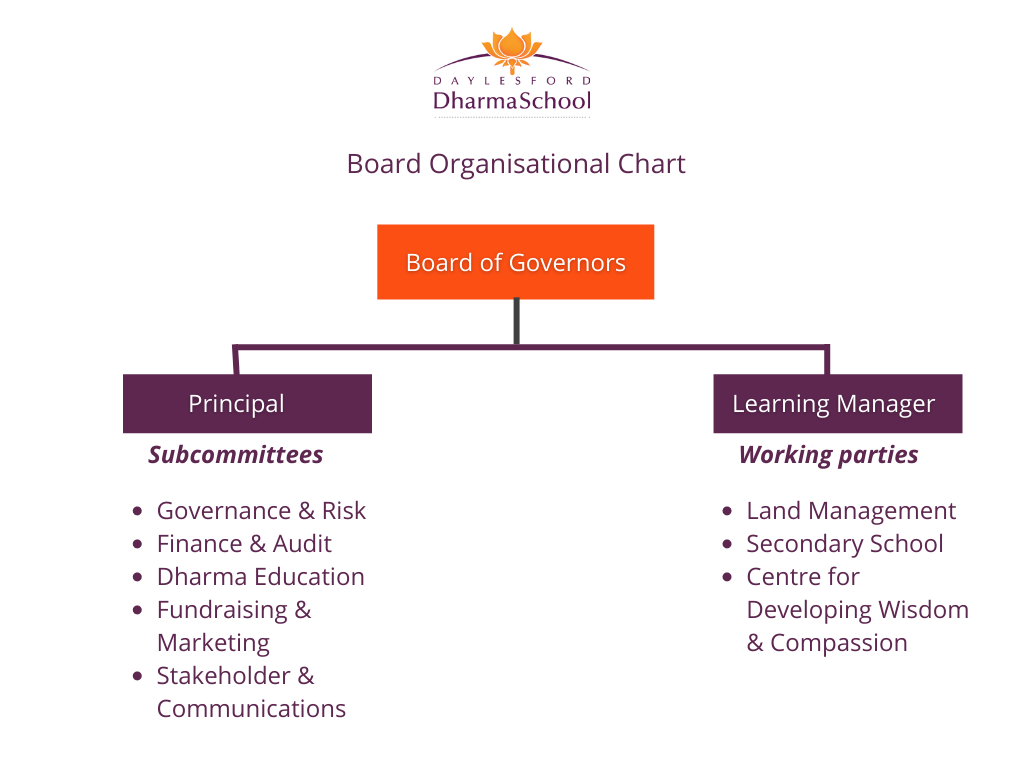
The Board is assisted by five permanent Sub-Committees that are ongoing and support the Board in a defined area of governance, and three project-based Working Parties that operate for a defined period or until the completion of a task. The Sub-committees are convened by the Board according to Terms of Reference and are open to membership from parents, staff, volunteers, and advisors, to enable our community to engage in supporting and developing the direction of the school. They report to the Board on a monthly basis and operate in harmony with the school’s ethos and behaviors.
Board Sub-committees:
- Finance & Audit committee – Treasurer, Chairperson, Principal.
- Governance & Risk committee – All Board members from 2020.
- Dharma Education committee – Dr Sue Smith (Chairperson), Venerable Geshe Konchok Tsering (Honorary Sangha Advisor & School Founder), Venerable Phuoc Tan OAM (Honorary Sangha Advisor), Tanya Wiggins, Dr Genevieve Blades, Professor Zane Diamond, Sevilla Furness-Holland (Secretary).
- Fundraising & Marketing committee – Principal, Gabrielle Magree (parent representative), Board members, Invitees.
- Stakeholders and Communications Committee – Dorje Warren Gibson, Fiona Robson (parent representative), Principal.
Board Working parties:
- Land Management working party – Principal, Tanya Wiggins (Learning Manager), Miri Taube (parent representative)
- Middle Years School Working Party – TBC
- Centre for Cultivating Wisdom Compassion project – TBC
Our Board meets monthly to manage the school’s finances, fulfil its legal obligations and track our strategic objectives against our Action plan. We ensure that the school’s philosophy is embedded in the school culture, education practices and all operations. We are committed to implementing the practice of dharma and ethics in our corporate management and leadership of the school.
DDS is a not-for-profit Incorporated Association with tax concession charity status, governed by a Board of Governors comprising between five and nine Board Members. In 2011 the Australian Taxation Office endorsed the school as a deductible gift recipient (DGR) for our School Building Fund.
Our school is led by the Principal who is appointed by the Board and is supported by the Learning Manager, and a team of Teachers, Learning Assistants and Administrative Staff.
The school operates under the philosophical patronage of Geshe Konchok Tsering – school founder, Tibetan Buddhist monk and Australian resident.
The school’s governance, operational structure and its staff, draw from the wisdom of the philosophical teachings of Shakyamuni Buddha and reflect and take guidance from the Mahayana lineage teachings of His Holiness, the 14th Dalai Lama, Tenzin Gyatso.
The Board and School Organisation Structures are set out in the following chart.
Democratical Principles
Daylesford Dharma School was established in 2009 within the guidelines for the registration of a school within the State of Victoria. Our school is committed to operating within the State and Federal Laws with adherence to the policies and expectations of the legally appointed authorities that oversee the operation of educational institutions in this State. In this regard, we commit to the principles of liberal democracy:
- We believe in an accountable and transparent, democratically elected government.
- We respect and observe the rule of law and believe that no person is above the law.
- We believe in equal rights for all before the law, regardless of race, ethnicity, religion, sexuality, gender, or other attributes.
- We believe not only in the freedom of religion, but also in the need to practice acceptance and understanding of others’ beliefs.
- We believe in the value of freedom of speech and freedom of association, yet also, acknowledge that we have a responsibility to act with Non-harm to others with this freedom.
- We believe in the values of openness and tolerance, and value and respect for all members of our diverse community.
Additionally, we value a peaceful, pluralistic and compassionate society. We acknowledge that this can be difficult to achieve despite living in a liberal democracy, and so we support our students and learning community to develop conflict resolution skills and peaceful communication, and to take responsibility for being a diverse society that is able to live harmoniously in sustainable coexistence.
Meetings
The Board meets on a regular basis once a month and also as smaller working groups as needed. We welcome open communication and any letters submitted to the board will be tabled for the next upcoming meeting for consideration. Please email: secretary@dharmaschool.com.au